
Jewelry Wire Size Guide: Wire Gauge to Millimetres Explained
Jewelry Wire Size Guide: Wire Gauge to Millimetres Explained
When shopping for jewelry wire, one of the most common questions is: “What does wire gauge mean in millimetres?”
If you have ever seen wire listed as 20 gauge, 24 gauge, or 26 gauge and wondered how thick it actually is, you are definitely not alone. Jewelry wire sizing can be a little confusing at first because many wires are measured using the gauge system, while beads, findings, and finished jewelry measurements are often listed in millimetres.
This guide will help you understand how wire gauge works, how it converts to millimetres, and which wire sizes are commonly used for different jewelry-making projects.
Looking for jewelry wire for your next project? You can browse our selection of 14K Gold Filled Wires, 14K Rose Gold Filled Wires, 925 Sterling Silver Wires, Shaping Wires, and Stringing Wires.
What Does Wire Gauge Mean?
Wire gauge refers to the thickness of the wire. The important thing to remember is:
The higher the gauge number, the thinner the wire.
For example, 26 gauge wire is thinner than 20 gauge wire. This can feel backwards at first, but once you get used to it, it becomes much easier to choose the right wire for your project.
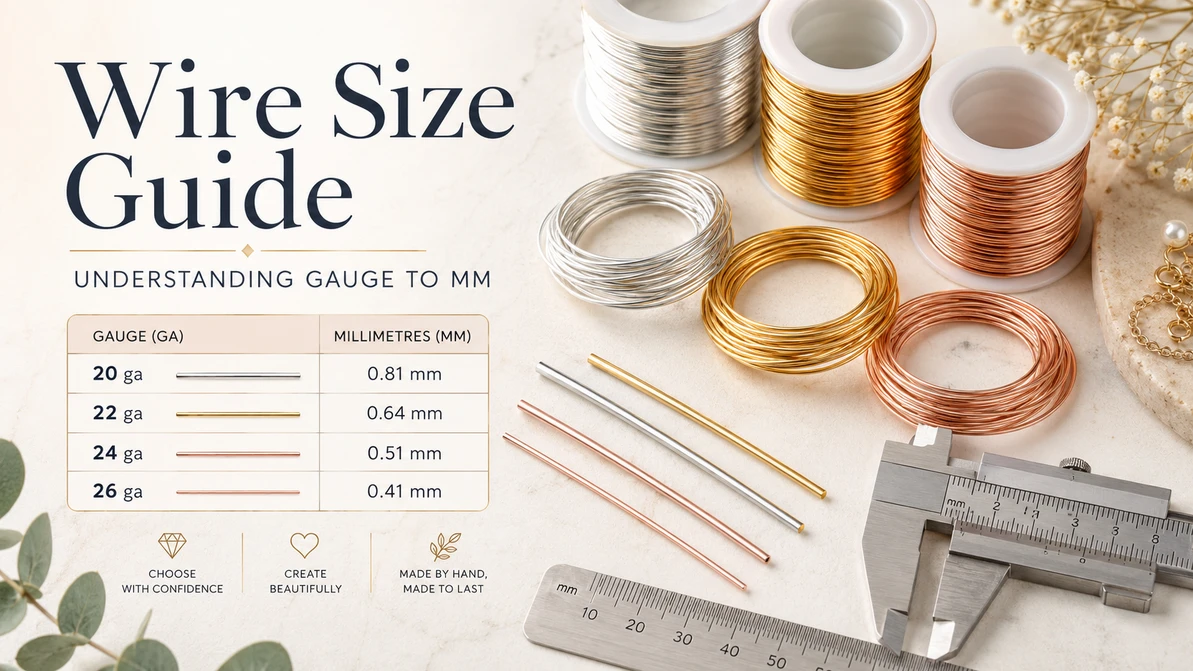
Wire Gauge to Millimetres Conversion Chart
Here is a helpful chart showing common jewelry wire gauges and their approximate thickness in millimetres.
| Wire Gauge | Approx. Size in mm | Common Jewelry Use |
|---|---|---|
| 14 gauge | 1.63 mm | Heavy bangles, cuffs, sturdy structural designs |
| 16 gauge | 1.29 mm | Heavy jump rings, clasps, frames, wire-wrapped components |
| 18 gauge | 1.02 mm | Ear wires, clasps, heavier wire wrapping, rings |
| 20 gauge | 0.81 mm | Ear wires, wrapped loops, head pins, general wire work |
| 21 gauge | 0.72 mm | Delicate ear wires, wrapping, medium-strength projects |
| 22 gauge | 0.64 mm | Wrapped loops, bead links, light wire wrapping |
| 24 gauge | 0.51 mm | Small gemstone beads, fine wrapping, delicate bead links |
| 26 gauge | 0.41 mm | Fine wire wrapping, small beads, briolettes |
| 28 gauge | 0.32 mm | Very delicate wrapping, weaving, tiny beads |
| 30 gauge | 0.25 mm | Fine wire weaving and very delicate detail work |
Which Wire Size Should You Choose?
The best wire size depends on what you are making. A thicker wire gives more strength and structure, while a thinner wire is easier to bend and works better for delicate details.
For Wire Wrapping Beads
For most gemstone bead wrapping, 22 gauge, 24 gauge, and 26 gauge are popular choices.
If the bead holes are small, especially with tiny gemstone beads, you may need a thinner wire such as 26 gauge. For larger beads or stronger links, 22 gauge or 24 gauge may be better.
For precious metal wire wrapping, browse our 14K Gold Filled Wires, 14K Rose Gold Filled Wires, and 925 Sterling Silver Wires.
For Ear Wires
20 gauge is one of the most common choices for handmade ear wires. It is strong enough to hold its shape while still being comfortable for most pierced ears.
Some makers prefer 21 gauge for a slightly thinner and more flexible ear wire.
For Jump Rings and Clasps
For jump rings, clasps, and components that need strength, thicker wire is usually better. Common choices include 18 gauge, 16 gauge, and sometimes 14 gauge, depending on the design.
For Delicate Wire Weaving
For wire weaving and very detailed designs, thinner wire such as 28 gauge or 30 gauge is often used. These sizes are very flexible and easy to weave around a thicker base wire.
You can also browse our Shaping Wires for wire-forming and design projects.
Wire Gauge and Bead Hole Size
When using wire with gemstone beads, always consider the bead hole size. Natural gemstone beads can have slight variations in hole size, even within the same strand.
As a general guide:
- 24 gauge wire works well with many small to medium gemstone beads.
- 26 gauge wire is better for smaller beads or beads with tighter holes.
- 22 gauge wire may not fit through some small gemstone beads.
Because natural stones can vary, it is always a good idea to test the wire with your beads before starting a full project.
Jewelry Wire vs. Stringing Wire
It is also helpful to understand the difference between regular jewelry wire and stringing wire.
Jewelry wire is usually used for wire wrapping, forming loops, making components, and creating decorative designs. It is often listed by gauge, such as 20 gauge, 22 gauge, or 24 gauge.
Stringing wire, on the other hand, is usually used for beaded bracelets and necklaces. It is commonly listed by millimetre thickness, such as 0.30mm or 0.38mm, rather than by gauge.
For beaded necklace and bracelet projects, browse our Stringing Wires.
Soft, Half-Hard, and Hard Wire
Wire thickness is not the only thing that matters. The temper of the wire also affects how it behaves.
- Dead soft wire is very flexible and easy to shape. It is great for wire wrapping and weaving.
- Half-hard wire holds its shape better and is useful for ear wires, clasps, and wrapped loops.
- Hard wire is more difficult to bend but keeps its form well for structural designs.
For beginners, dead soft and half-hard wire are usually the easiest to work with.
Quick Beginner Recommendation
If you are just starting out, here are three useful wire sizes to have on hand:
- 20 gauge for ear wires and stronger components
- 24 gauge for general bead wrapping
- 26 gauge for smaller gemstone beads and delicate wrapping
Final Thoughts
Understanding wire gauge makes jewelry making much easier. Just remember: the larger the gauge number, the thinner the wire.
For gemstone jewelry, the most commonly used wire sizes are usually between 20 gauge and 26 gauge, depending on the bead size, bead hole, and type of design. When in doubt, choose a slightly thinner wire for small beads and a thicker wire when you need more strength.
With the right wire size, your jewelry pieces will be easier to make, more secure, and more comfortable to wear.
Ready to choose your wire? Shop our 14K Gold Filled Wires, Rose Gold Filled Wires, Sterling Silver Wires, Shaping Wires, and Stringing Wires.
Recent Posts
-
Bead Hole Size Guide: How to Choose the Right Cord or Wire
Bead Hole Size Guide: How to Choose the Right Cord or Wire An 8 mm gemstone bead tells you how wide …25th Sep 2026 -

12 Most Popular Gemstone Beads for Jewelry Making
12 Most Popular Gemstone Beads for Jewelry Making Gemstone beads are available in an extraordinary …11th Aug 2026 -
Natural vs. Treated Gemstones: Dyed, Heated and Stabilized Explained
Natural, Dyed, Heated and Stabilized Gemstones Explained When shopping for gemstone beads, you may s …24th Jul 2026