
Moonstone vs. Labradorite: Differences, Colors and Uses
Moonstone vs. Labradorite: What’s the Difference?
Moonstone and labradorite are often compared because both gemstones can display a beautiful glow that seems to move across the surface. Although they may look similar at first glance, they have distinct colours, optical effects and design possibilities.
Both stones belong to the feldspar mineral family, but their appearance and character are quite different. Understanding these differences can help you choose the right gemstone beads for your next jewelry-making project.
Are Moonstone and Labradorite Related?
Yes. Moonstone and labradorite are both members of the feldspar mineral group, one of the most abundant groups of minerals found in the Earth’s crust.
However, they form under different conditions and produce different visual effects.
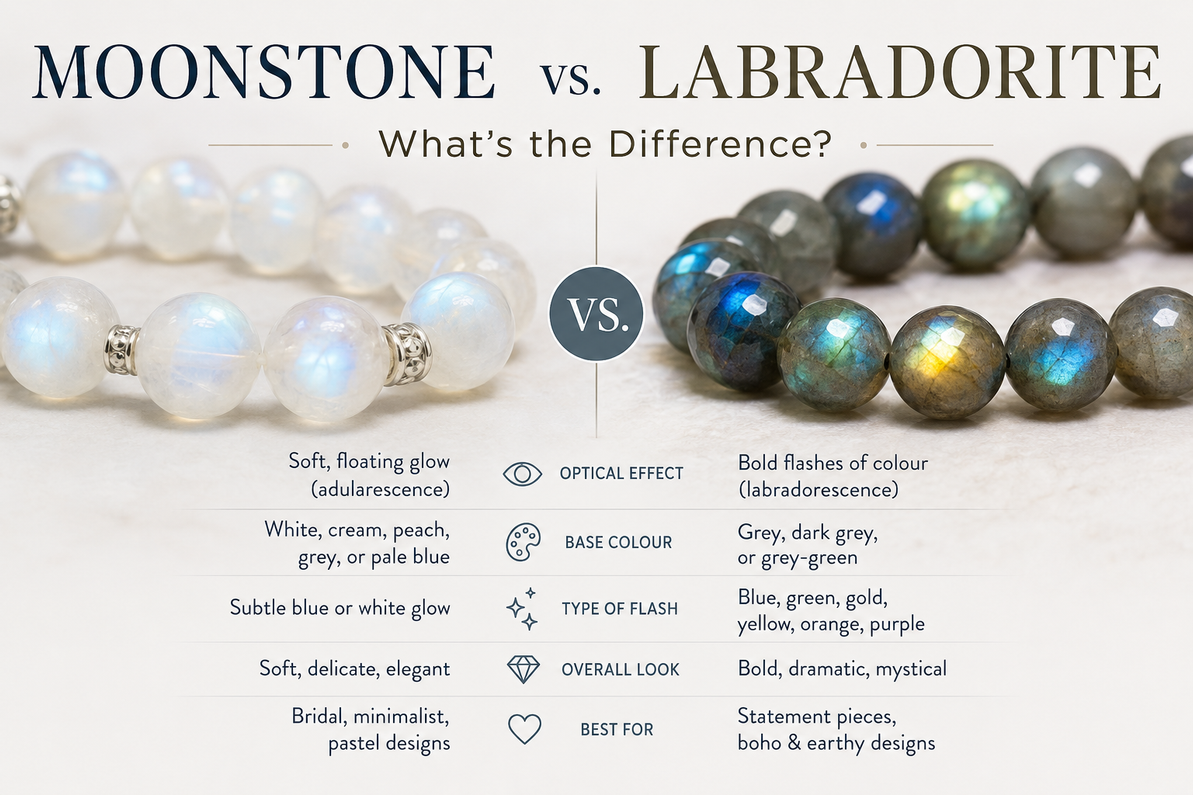
Moonstone is known for its soft, floating glow, while labradorite is famous for bold flashes of blue, green, gold and other colours.
What Is Moonstone?
Moonstone is a feldspar gemstone valued for an optical effect known as adularescence.
Adularescence appears as a soft glow that seems to float beneath the surface of the stone. As the bead moves, the light may shift gently from one area to another.
Moonstone commonly appears in shades such as:
- White
- Cream
- Peach
- Grey
- Colourless
- Pale blue
Some moonstone beads have a subtle glow, while higher-quality stones may display a noticeable blue flash.
Because of its soft and luminous appearance, moonstone is often used in delicate, romantic and minimalist jewelry designs. You can explore our available white moonstone beads or browse our complete selection of gemstones by name.
What Is Labradorite?
Labradorite is another feldspar gemstone, but it is known for an optical effect called labradorescence.
Labradorescence produces brighter and more dramatic flashes of colour when light hits the stone from certain angles.
Common flashes include:
- Blue
- Green
- Gold
- Yellow
- Orange
- Purple
The base colour of labradorite is usually grey, dark grey or grey-green. At first glance, some beads may appear fairly neutral. When they move under the light, colourful flashes can suddenly become visible.
This dramatic colour effect makes labradorite beads especially popular for statement jewelry and designs with a mysterious or earthy appearance.
Moonstone vs. Labradorite: Key Differences
Optical Effect
Moonstone displays adularescence, which creates a soft and diffused glow.
Labradorite displays labradorescence, which produces stronger flashes of colour.
Base Colour
Moonstone is usually white, cream, peach, grey or colourless.
Labradorite normally has a darker grey or grey-green base.
Type of Flash
Moonstone often shows a white or blue floating glow.
Labradorite can display flashes of blue, green, gold, orange, purple and yellow.
Overall Appearance
Moonstone has a softer and more delicate look.
Labradorite has a darker, bolder and more dramatic appearance.
Jewelry Style
Moonstone works beautifully in bridal jewelry, minimalist designs and soft pastel colour palettes.
Labradorite is ideal for statement pieces, bohemian designs and jewelry featuring darker or richer colours.
Is Rainbow Moonstone Actually Moonstone?
Despite its name, rainbow moonstone is generally considered a variety of transparent or white labradorite.
It often has a light-coloured body with flashes of blue, green or rainbow tones. Its appearance resembles moonstone, which is why it is commonly sold under the name rainbow moonstone.
This means that traditional moonstone and rainbow moonstone are related, but they are not technically the same material.
Which Stone Is Better for Jewelry Making?
Neither gemstone is necessarily better. The right choice depends on the look you want to create.
Choose moonstone when you want:
- A soft and elegant appearance
- Light or neutral colours
- Subtle flashes
- Romantic or minimalist jewelry
- Designs that pair well with pearls and delicate findings
Choose labradorite when you want:
- Bold flashes of colour
- Darker neutral tones
- Earthy or dramatic jewelry
- Statement necklaces or bracelets
- Designs that change appearance under different lighting
How to Use Moonstone in Jewelry
Moonstone pairs especially well with:
- Freshwater pearls
- Rose quartz
- Aquamarine
- Clear quartz
- Sterling silver
- Gold-filled findings
Small moonstone beads can create delicate bracelets and necklaces, while larger faceted beads can become the focal point of a design.
Because the glow can vary from bead to bead, rotating the beads while designing can help you position the strongest flashes where they will be most visible.
Complete your design with clasps, jump rings, spacer beads and other jewelry findings.
How to Use Labradorite in Jewelry
Labradorite pairs beautifully with:
- Black spinel
- Onyx
- Smoky quartz
- Hematite
- Moonstone
- Sterling silver
- Antique-style findings
Faceted labradorite beads can reflect additional light and make the flashes more noticeable. Smooth beads provide a softer, more organic appearance.
When planning a labradorite design, examine each bead from several angles. The colourful flash may be visible only from a particular direction.
Why Do Some Beads Have More Flash Than Others?
The optical effects in moonstone and labradorite depend on the internal structure of the gemstone and the angle at which it is cut.
For this reason, natural beads can vary in:
- Colour
- Transparency
- Pattern
- Flash intensity
- Location of the flash
- Natural inclusions
Not every bead will display the same amount of glow or colour. These natural variations are part of what makes gemstone jewelry unique.
To learn more about natural characteristics, read our guide to inclusions, cracks and colour variations in natural gemstone beads.
Lighting also makes a difference. A stone that appears subtle indoors may show a much stronger flash in sunlight or under direct lighting.
How to Care for Moonstone and Labradorite
Moonstone and labradorite are suitable for jewelry, but they should still be handled carefully.
To protect your jewelry:
- Avoid dropping the stones onto hard surfaces
- Keep them away from harsh household chemicals
- Remove jewelry before swimming or exercising
- Store pieces separately to prevent scratching
- Clean them with a soft cloth and mild soapy water
- Avoid ultrasonic and steam cleaners
Bracelets should be designed with a comfortable fit so the beads are not constantly hitting hard surfaces. Before making a bracelet, see our guide on how to measure your wrist for a beaded bracelet.
You can also use our guide to determine how many beads you need to make a bracelet.
Final Thoughts
Moonstone and labradorite are closely related gemstones, but they create very different visual effects.
Moonstone offers a soft, floating glow that is ideal for elegant and delicate jewelry. Labradorite provides bold flashes of colour that work beautifully in dramatic, earthy and statement designs.
Whichever stone you choose, natural variations in colour and flash ensure that every finished piece will have its own unique character.
Ready to start your next jewelry project?
Shop our selection of moonstone beads, explore our labradorite beads, or browse all gemstone beads at Fine Gems Canada.
Recent Posts
-
Bead Hole Size Guide: How to Choose the Right Cord or Wire
Bead Hole Size Guide: How to Choose the Right Cord or Wire An 8 mm gemstone bead tells you how wide …25th Sep 2026 -
12 Most Popular Gemstone Beads for Jewelry Making
12 Most Popular Gemstone Beads for Jewelry Making Gemstone beads are available in an extraordinary …11th Aug 2026 -
Natural vs. Treated Gemstones: Dyed, Heated and Stabilized Explained
Natural, Dyed, Heated and Stabilized Gemstones Explained When shopping for gemstone beads, you may s …24th Jul 2026