
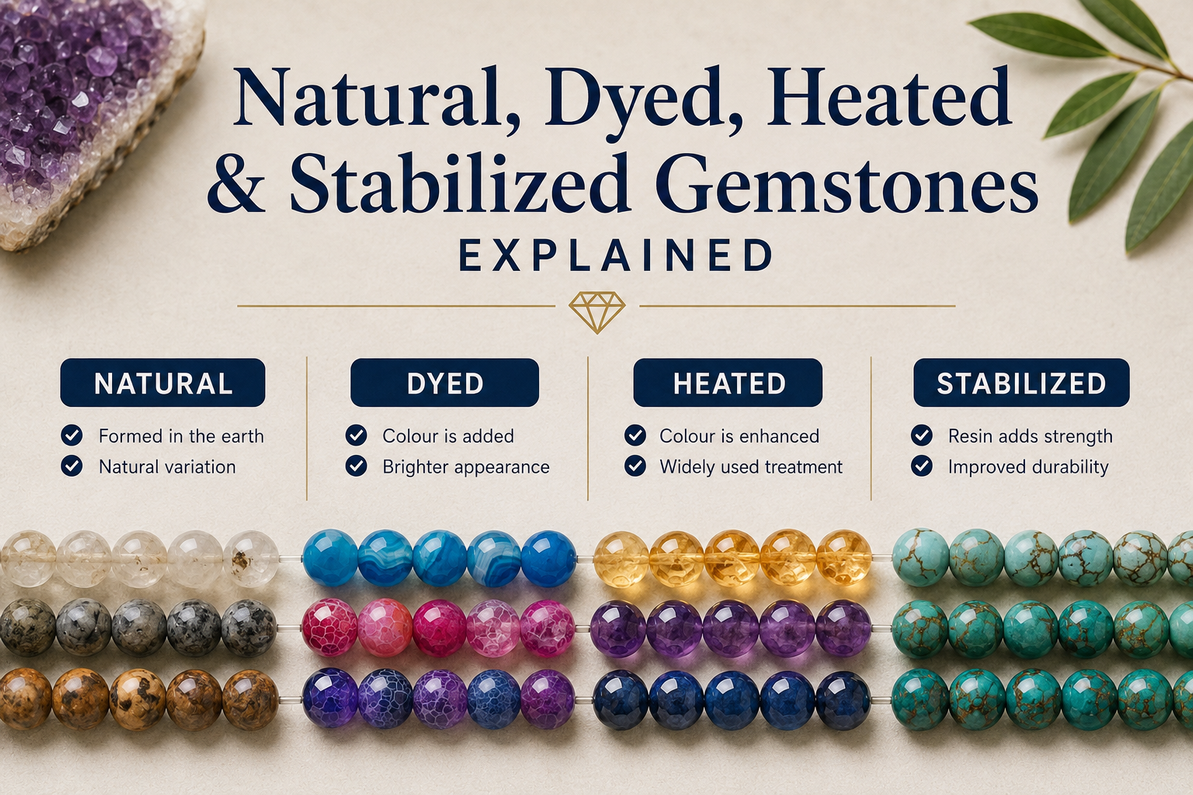
Natural vs. Treated Gemstones: Dyed, Heated and Stabilized Explained
Natural, Dyed, Heated and Stabilized Gemstones Explained
When shopping for gemstone beads, you may see descriptions such as natural, dyed, heated or stabilized. These terms describe whether a gemstone has been treated after it was mined.
Gemstone treatments are common throughout the jewellery industry. Some improve colour, while others increase durability or make naturally porous material suitable for everyday jewellery. A treated gemstone is not necessarily fake or poor quality—it is simply important to understand what the terminology means.
This guide explains four common descriptions so you can choose the right gemstone beads for your jewellery-making projects.
What Is a Natural Gemstone?
A natural gemstone is a material formed through geological processes rather than manufactured in a laboratory.
However, the word natural does not always mean untreated. A gemstone can be natural in origin while also having been heated, dyed, stabilized or otherwise enhanced after mining.
For example, a natural sapphire may have been heated to improve its colour. It remains a natural sapphire because the stone itself formed in the earth, but its appearance has been enhanced.
When a gemstone is described as natural and untreated, it generally means that it has not received a known colour or clarity enhancement beyond ordinary cutting, drilling and polishing.
Natural gemstones frequently display:
- Variations in colour and pattern
- Mineral inclusions
- Small pits or surface irregularities
- Differences between beads on the same strand
- Variations in transparency or opacity
These characteristics are normal and are part of what makes genuine gemstone beads distinctive. Two natural gemstone strands may resemble each other without being completely identical.
What Are Dyed Gemstones?
Dyeing introduces colour into a gemstone to strengthen its existing colour, produce a more consistent appearance or create a colour that may not occur naturally.
Porous materials such as agate, howlite, quartzite and some forms of jade are particularly receptive to dye. Dye can penetrate small pores and fractures rather than simply sitting on the surface.
Gemstones may be dyed to:
- Intensify a pale natural colour
- Make colour more uniform
- Create bright or unusual colours
- Offer fashionable colours at an accessible price
- Imitate the general appearance of a more expensive gemstone
Dyed gemstones are still made from genuine mineral material when the underlying bead is a natural stone. The added colour does not automatically make the bead synthetic or imitation, although the treatment should be identified whenever it is known.
Does Gemstone Dye Last Permanently?
The durability of a dye depends on the stone, the colouring process and how the jewellery is cared for. Some dyed gemstones maintain their colour for many years, while others may fade or transfer when exposed to sunlight, heat, chemicals or prolonged moisture.
To protect dyed gemstone jewellery:
- Avoid soaking it in water
- Keep it away from perfume, hairspray and cleaning chemicals
- Do not use ultrasonic or steam cleaners unless the material is known to be safe
- Store it away from prolonged direct sunlight
- Wipe it gently with a soft, slightly damp cloth
Brightly coloured beads can be beautiful design materials, but they should be chosen with an understanding that their colour may have been enhanced.
What Are Heat-Treated Gemstones?
Heat treatment exposes a gemstone to controlled temperatures to alter or improve its colour, clarity or overall appearance.
Heating is one of the oldest and most widely used gemstone treatments. Depending on the mineral, controlled heating may lighten, darken or change its colour. It can also reduce the visibility of certain inclusions.
Gemstones commonly associated with heat treatment include:
- Sapphire
- Ruby
- Aquamarine
- Citrine
- Amethyst
- Tanzanite
- Zircon
- Tourmaline
In some cases, heat treatment creates the colour most consumers normally associate with a gemstone. Much of the blue tanzanite available in the jewellery market, for example, has been heated to develop or strengthen its blue and violet appearance.
Is Heat Treatment Permanent?
Many conventional heat treatments are stable under normal jewellery-wearing conditions. The result does not simply wash away because heat alters properties within the gemstone rather than adding a coloured surface layer.
However, heat-treated gemstones should still be protected from sudden temperature changes. Extreme heat can damage some stones, inclusions or jewellery components regardless of whether the gemstone was previously treated.
Heat treatment does not make a natural gemstone synthetic. A mined sapphire that has been heated is still a natural sapphire, but it should be described as heat treated when that information is known.
What Are Stabilized Gemstones?
Stabilization is used primarily on gemstones that are naturally soft, chalky, porous or prone to breaking.
During stabilization, a clear resin or polymer is introduced into the material’s pores. Once hardened, it strengthens the stone and can make it easier to cut, polish, drill and wear.
Stabilized turquoise is one of the most common examples. Some turquoise is too soft or porous to withstand regular jewellery use in its untreated form. Stabilization allows more of the mined material to be turned into durable, polished beads.
Stabilization can:
- Strengthen porous gemstone material
- Reduce crumbling and breakage
- Improve the ability to hold a polish
- Make drilling and shaping more reliable
- Reduce the absorption of oils and moisture
- Improve consistency for jewellery making
A stabilized gemstone generally remains genuine gemstone material. It should not be confused with a completely synthetic product, although resin has been added to improve its structure.
Stabilized vs. Reconstituted Gemstones
These terms do not mean exactly the same thing.
A stabilized gemstone is generally natural material that has been strengthened by filling its pores with resin or another substance.
A reconstituted gemstone is typically made from small pieces or powdered gemstone material that have been combined with a binding agent and formed into a new shape.
Both can be useful jewellery materials, but their composition and manufacturing processes are different.
Are Treated Gemstones Fake?
No. Treatment alone does not make a gemstone fake.
A natural stone may be heated, dyed or stabilized while remaining mineral material that originally formed in the earth. The important distinction is whether the treatment is accurately represented.
- Natural gemstone: Formed in the earth
- Treated gemstone: Natural material whose colour, clarity or durability has been enhanced
- Synthetic gemstone: Created in a laboratory with essentially the same chemical and crystal structure as its natural counterpart
- Imitation gemstone: A different material made to resemble another gemstone
- Reconstituted gemstone: Gemstone particles or fragments combined with a binding material
Treated gemstones often make attractive colours and jewellery designs available at more accessible prices. Problems arise primarily when a treated material is represented as untreated or as a rarer gemstone than it actually is.
Why Are Gemstones Treated?
Gem-quality material with strong natural colour, good durability and few visible imperfections is relatively uncommon. Treatments allow more mined material to be used instead of discarded.
Jewellery makers may choose treated gemstones because they provide:
- Brighter or more consistent colours
- Improved durability
- Better availability
- More predictable results between strands
- Lower prices than comparable untreated material
- A wider selection of colours and design possibilities
Untreated stones may be preferred for their rarity and natural appearance, while treated stones may be selected for their colour, consistency, strength or affordability. Neither option is automatically better for every project.
How Can You Tell Whether a Gemstone Has Been Treated?
Some treatments produce visible clues, but it is not always possible to identify a treatment by appearance alone.
Possible signs of dyeing can include:
- Colour concentrated around drill holes
- Colour collecting inside surface fractures
- Unusually intense or uniform colour
- Colour residue on the string
- Colour transferring to a damp cloth
These clues are not definitive. Sophisticated treatments can be difficult or impossible to identify without gemological equipment and specialized testing.
The safest approach is to read the product description and ask the supplier when treatment information is important to your project. Keep in mind that treatment history may not always be fully available, particularly with commercial-grade bead strands that have passed through several stages of the supply chain.
Caring for Treated Gemstone Beads
- Keep gemstones away from household chemicals, perfume and hairspray.
- Remove jewellery before swimming, showering or exercising.
- Avoid prolonged exposure to direct sunlight and high heat.
- Clean beads gently with a soft cloth.
- Avoid steam and ultrasonic cleaning unless the gemstone and treatment are known to tolerate them.
- Store pieces separately to prevent scratching.
- Handle softer and porous gemstones with extra care.
Choosing the Right Gemstones for Your Designs
Natural and treated gemstones can both be excellent choices for bracelets, necklaces and earrings. The right option depends on the appearance, durability, consistency and price point required for your design.
Untreated gemstones highlight the variation and character produced by nature. Dyed stones offer creative colours, heated stones may display enhanced beauty, and stabilized stones provide added strength for materials that might otherwise be too fragile for regular wear.
Understanding these terms allows jewellery makers to purchase confidently, accurately describe their creations and help their own customers make informed decisions.
Explore our collection of gemstone beads for jewellery making to discover colours, sizes and materials for your next project.
Recent Posts
-
Bead Hole Size Guide: How to Choose the Right Cord or Wire
Bead Hole Size Guide: How to Choose the Right Cord or Wire An 8 mm gemstone bead tells you how wide …25th Sep 2026 -
12 Most Popular Gemstone Beads for Jewelry Making
12 Most Popular Gemstone Beads for Jewelry Making Gemstone beads are available in an extraordinary …11th Aug 2026 -
Natural vs. Treated Gemstones: Dyed, Heated and Stabilized Explained
Natural, Dyed, Heated and Stabilized Gemstones Explained When shopping for gemstone beads, you may s …24th Jul 2026