
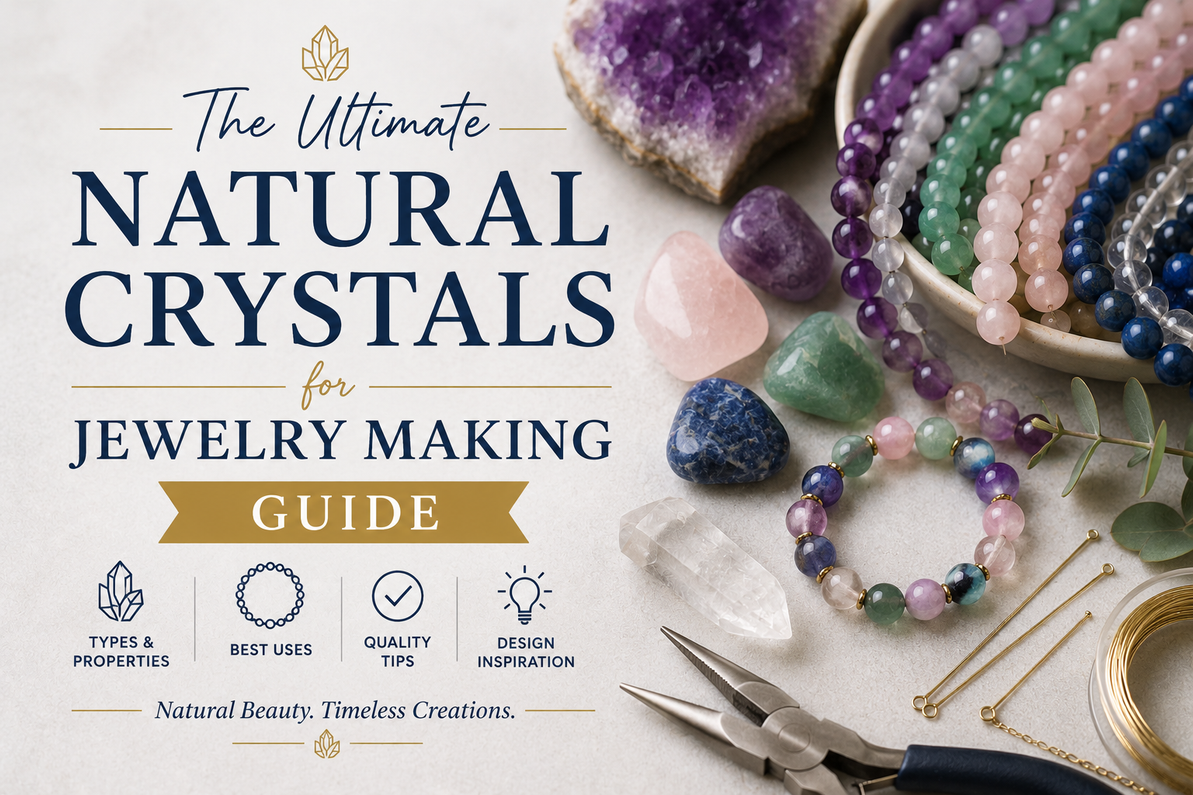
Natural Crystals for Jewelry Making Guide
A strand that looks perfect on screen can still slow down production if the drill holes are tight, the sizing runs off, or the color match is inconsistent from batch to batch. That is why sourcing natural crystals for jewelry making is not just about appearance. For makers selling finished pieces, teaching classes, or keeping a steady studio workflow, the real question is whether the material will hold up in design, assembly, and repeat ordering.
Natural crystal beads bring range that synthetic materials usually cannot match. You get variation in pattern, tone, translucency, and surface character, which is exactly what many customers want in gemstone jewelry. At the same time, natural material requires a more careful buying process. One stone type may be ideal for minimalist stretch bracelets, while another makes more sense for wrapped pendants, earrings, or higher-end matched designs.
What to look for in natural crystals for jewelry making
The first filter is stone type, but that should not be the only one. Shape, size, cut, drill quality, and consistency across a strand all affect how efficiently a material works in production. If you are building jewelry for sale rather than one-off personal projects, these details matter just as much as the name of the gemstone.
Round gemstone beads are usually the most flexible starting point because they suit bracelets, necklaces, rosaries, and simple earring designs. Faceted rounds add more light return and can help a straightforward design read as more finished without adding extra components. Rondelles and heishi-style spacers can tighten the visual rhythm of a piece, but they also require more attention to spacing, hole size, and alignment.
Drill holes deserve close attention. A strand with small or inconsistent holes can create problems with thicker cord, multiple passes of wire, or head pins that need smooth seating. This becomes more noticeable when working with stones that already vary in hardness or internal structure. If you regularly produce on beading wire, elastic, or fine chain components, drill consistency can save a lot of assembly time.
Color consistency is another practical factor. Natural stone variation is expected, but there is a difference between attractive variation and difficult-to-match inventory. If your business depends on repeatable product lines, it helps to source from a supplier with enough category depth to restock similar stones, sizes, and supporting findings in the same order.
Choosing the right crystal type for the design
Not every natural crystal performs the same way in jewelry. Some are chosen for clean, versatile color. Others are chosen for pattern, rarity, or texture. The best choice depends on the design style, price point, and how much variation your customer is likely to welcome.
Quartz varieties are often the easiest place to start. Clear quartz, rose quartz, smoky quartz, and amethyst fit a wide range of designs and pair well with sterling silver, gold-filled, stainless steel, and vermeil components. They are familiar to buyers, generally easy to merchandise, and available in multiple cuts and sizes. For sellers, that makes them useful anchor materials for core collections.
Agate and jasper offer more pattern and earthy color variation. These stones work well when the design needs visual interest without relying on elaborate metalwork. They are especially useful in bracelets and longer necklaces where the bead surface can carry the design. The trade-off is that highly patterned strands can be harder to match for earrings or symmetrical sets.
Labradorite, moonstone, and similar optical stones are strong sellers when flash and surface effect matter. They can elevate a simple silhouette, but quality grading matters more here than with more uniform materials. A low-grade strand may still work for casual designs, while premium pieces call for stronger fire, cleaner body color, and better matching.
Tourmaline, garnet, aquamarine, and other finer gemstone options usually fit better in elevated or boutique lines. They can support a higher finished price, especially in faceted or micro-faceted formats. These stones also tend to require more careful planning around bead size, spacing, and metal choice because the material cost is higher and waste matters more.
Bead size, shape, and cut affect the final result
A good design can fail on proportion. That is why bead size should be selected with the full project in mind, not in isolation. A 4mm round may be ideal for stackable bracelets and delicate layering pieces, while 6mm and 8mm rounds usually suit broader retail appeal because they are easy to style and read clearly on display.
Smaller faceted beads often create a more refined finish, especially in necklaces with fine chain, wire wrapping, or metal accents. Larger smooth rounds can feel stronger and more commercial in stretch bracelets and unisex styles. Neither is better across the board. It depends on the target customer, the amount of metal in the design, and the intended selling price.
Shape also affects labor. Coins, nuggets, and freeform cuts can look distinctive, but they take more time to arrange and often need more design correction during assembly. Uniform rounds and rondelles are faster for production runs. If speed matters, standard shapes usually reduce friction.
Matching crystals with the right findings and stringing materials
Natural gemstone beads do not perform well if the rest of the build is under-specified. A good strand still needs the right findings, wire, cord, crimps, and spacers to become a reliable finished piece.
For bracelets and necklaces, beading wire is often the safest option when using heavier or more valuable stones. It supports structure better than basic thread and helps reduce wear at the drill hole. Elastic works for stretch designs, but the bead edges, weight, and hole smoothness all matter. Some natural stones are more forgiving than others, and sharp internal edges can shorten the life of a stretch bracelet.
Metal choice changes the presentation immediately. Sterling silver and stainless steel tend to suit cooler-toned stones like labradorite, amazonite, aquamarine, and blue lace agate. Gold-filled and vermeil can warm up stones like garnet, citrine, sunstone, and many agates. This is not a strict rule, but it is a useful merchandising shortcut when building coordinated collections.
Spacer beads, bead caps, and connectors should support the stone rather than compete with it. With patterned crystals, simpler findings usually work better. With cleaner stones such as clear quartz or black onyx, decorative metal components can carry more of the visual weight.
Quality checks that matter before you buy more than one strand
If you are testing a stone for a new product line, it helps to evaluate a small quantity first. Check whether the strand length matches your production plan, whether the drill holes fit your preferred materials, and whether the finish is consistent enough for matched pieces.
Look closely at the cut and polish. Slight variation is normal in natural material, but chips around drill holes, overly rough facets, and poorly matched shapes can slow down assembly or create visible issues in a finished design. For earrings and symmetrical necklaces, matching is especially important.
It also helps to think about reorder risk. A stone may be attractive, but if the category is too narrow or the supply too inconsistent, it may not support a repeatable collection. Makers who need continuity usually benefit from sourcing from larger, organized inventories where gemstone beads, findings, tools, and stringing materials are stocked in one place.
Sourcing natural crystals for jewelry making efficiently
Fragmented sourcing is one of the fastest ways to lose time and margin. When gemstone beads come from one supplier, metal findings from another, and basic tools from a third, every restock becomes slower and harder to manage. That affects both hobbyists and businesses, but it is especially costly for sellers working on deadlines or wholesale orders.
A better sourcing setup gives you access to natural crystals for jewelry making alongside the practical components needed to finish the job - head pins, crimp tubes, clasps, jump rings, chain, wire, cord, and packaging-adjacent basics. That makes product testing easier and reorder planning more predictable.
For North American makers, shipping speed also matters. If a supplier carries broad gemstone categories and can ship quickly from a central inventory, it reduces the need to overbuy backup stock. Fine Gems Canada is built around that kind of purchase-ready supply model, with gemstone beads, findings, and jewelry-making materials organized for both retail and wholesale ordering.
When natural crystals are the right choice
Natural crystals are usually the right choice when material identity matters to the customer, when the visual variation adds value, or when the design is meant to feel more specialized than mass-market fashion jewelry. They are also a practical fit for makers building recognizable gemstone-based collections.
That said, natural material is not always the easiest option for every project. If exact color uniformity is the top priority, or if the design relies on perfect duplication across large batches, some natural stones may require more sorting and planning than expected. The upside is that when you source well, natural gemstone beads give you a stronger materials story, broader design range, and a better foundation for jewelry that feels intentional rather than generic.
Start with stones that match your design style and production method, then build around supply consistency. Good materials should not just look good in a tray. They should help you make, restock, and ship with fewer surprises.
Recent Posts
-
Bead Hole Size Guide: How to Choose the Right Cord or Wire
Bead Hole Size Guide: How to Choose the Right Cord or Wire An 8 mm gemstone bead tells you how wide …25th Sep 2026 -
12 Most Popular Gemstone Beads for Jewelry Making
12 Most Popular Gemstone Beads for Jewelry Making Gemstone beads are available in an extraordinary …11th Aug 2026 -
Natural vs. Treated Gemstones: Dyed, Heated and Stabilized Explained
Natural, Dyed, Heated and Stabilized Gemstones Explained When shopping for gemstone beads, you may s …24th Jul 2026