
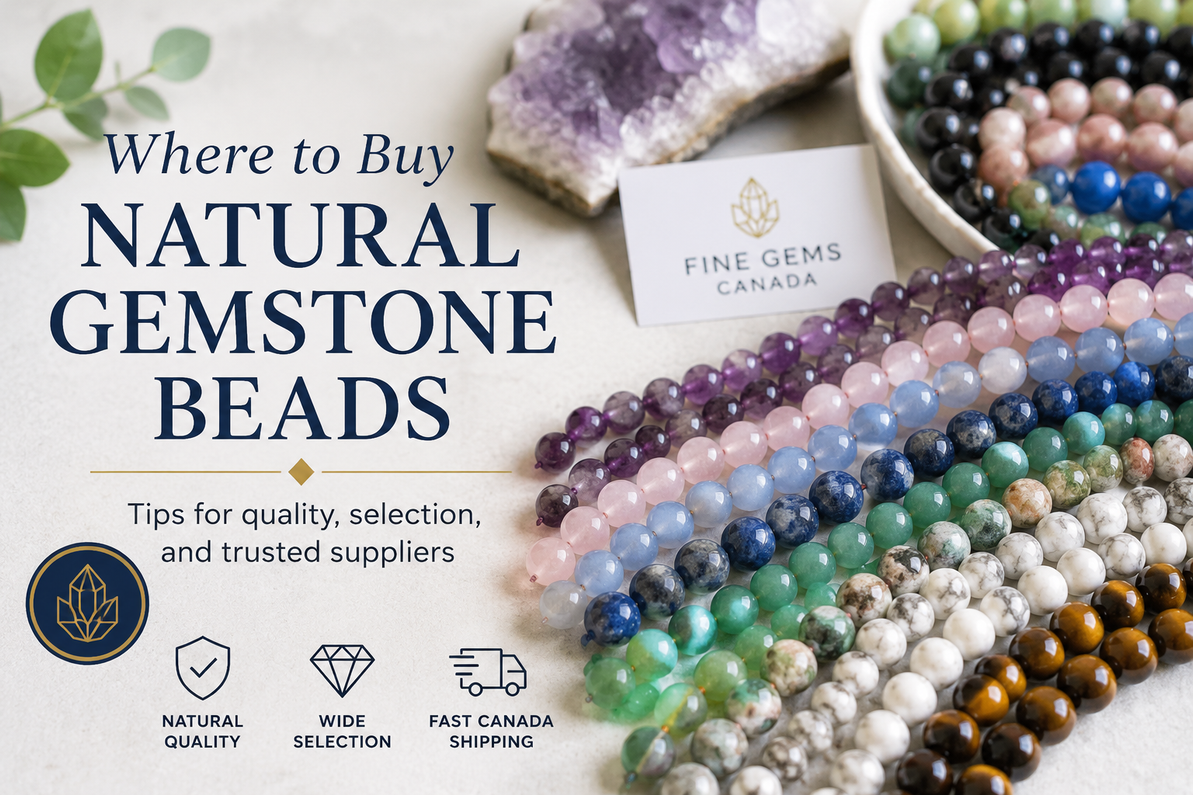
Where to Buy Natural Gemstone Beads
If you are deciding where to buy natural gemstone beads, the real question is not just who sells them. It is who can supply the exact stone, shape, size, drill quality, and matching components you need without forcing you to split an order across three or four vendors. For jewelry makers, Etsy sellers, and small brands, sourcing has to support production, not slow it down.
Where to buy natural gemstone beads depends on how you make jewelry
A hobbyist making a few bracelets each month can often work around gaps in stock or limited size options. A business cannot. If you are building repeatable designs, fulfilling customer orders, or testing a new collection, your bead supplier needs to offer consistency in inventory, practical navigation, and fast shipping.
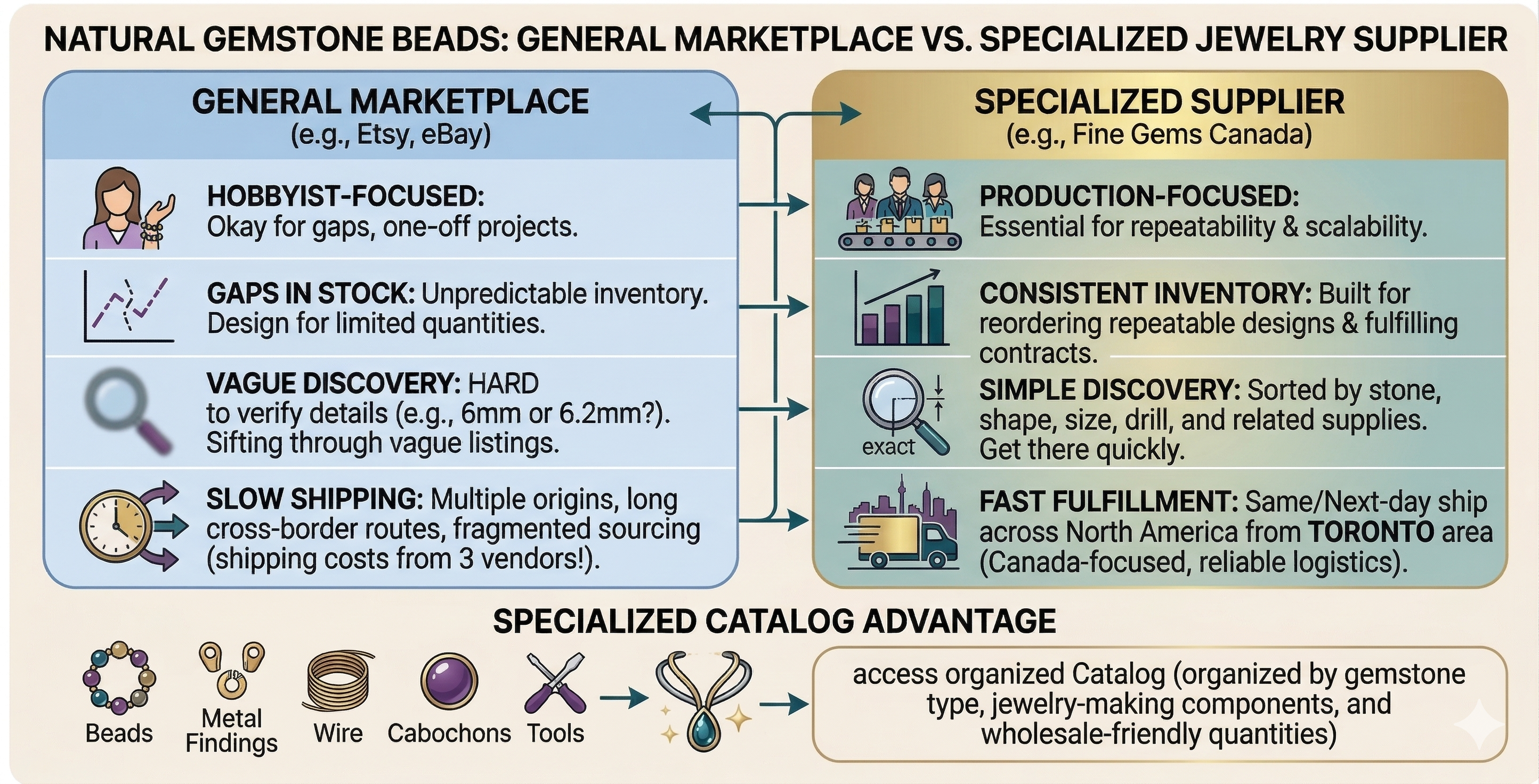
That is why the best place to buy natural gemstone beads is usually a specialized jewelry supply store rather than a general marketplace. Marketplaces can be useful for browsing, but they often make it harder to verify stone details, compare strand options, or source findings in matching metals at the same time. A dedicated supplier is built around materials, specifications, and reordering.
When you shop with a specialized source such as Fine Gems Canada, you are not just buying beads. You are buying access to a catalog organized by gemstone type, jewelry-making components, and wholesale-friendly quantities, with same-day or next-business-day shipping from the Toronto area to customers across North America.
What to look for before you place an order
The most useful suppliers make product discovery simple. That starts with a catalog that is sorted by stone type, bead shape, size, finish, and related supplies. If you already know you need 6mm round labradorite, faceted spinel, or smooth amethyst in a specific diameter, you should be able to get there quickly without guessing through vague listings.
Stock depth matters just as much as navigation. Some stores carry a wide range of gemstones but only in one or two sizes. Others have a lot of one-off inventory that looks good for browsing but does not help when you need repeat orders. If you design for resale, depth of selection is what allows you to move from sampling to production.
Pricing structure is another practical checkpoint. Retail buyers may be focused on strand value, while small brands and studios often need wholesale pricing or quantity flexibility. A supplier that serves both can save time as your purchasing needs grow. This is especially useful when you need gemstone beads, metal findings, cord, wire, and tools in the same order.
Then there is shipping. A strong catalog loses value if fulfillment is slow. For time-sensitive makers, fast order processing is not a bonus. It is part of the product. If your supplier ships same day or next business day, that can be the difference between finishing a collection on schedule and missing a sales window.
Quality signals that matter with natural gemstone beads
Natural gemstone beads are not factory-identical materials, and experienced makers know that variation is part of the appeal. Still, there is a difference between natural variation and poor sourcing. A good supplier should make it easier to buy with confidence by presenting beads in clearly defined categories and with enough specificity that you understand what you are getting.
Start with the basics. Look for clear naming by stone type and straightforward sizing. If the listings are inconsistent or overly broad, it becomes harder to judge whether you are buying a true material match or a loose substitute. Stone-specific organization is usually a sign that the business understands how makers shop.
Drill quality also matters more than many buyers expect. Even beautiful beads can slow production if holes are uneven, too small for your wire or cord, or prone to chipping at the drill point. This is harder to assess online, which is why repeat ordering from a reliable source tends to matter more than chasing the lowest price on each strand.
You should also think about project compatibility. The bead itself is only one part of the build. If you are making finished jewelry for sale, you also need access to dependable findings and materials in the right metal types, whether that is sterling silver, vermeil, stainless steel, or 14K gold filled. Buying from a supplier with a broad jewelry-making catalog reduces mismatch risk and keeps your builds consistent.
The trade-off between price and reliability
Every buyer wants competitive pricing, but the lowest listed price is not always the lowest true cost. If a cheaper strand arrives with poor color consistency, rough drilling, or dimensions that do not work with your design, you pay for it in production time and wasted materials.
This is where wholesale-oriented suppliers tend to stand out. They are built to support repeat buyers who care about margin, but they also understand that reliability drives repeat business. For makers, that often creates better overall value than ordering from scattered low-cost sources with uneven quality control.
There is also the cost of fragmented sourcing. If you buy gemstone beads from one shop, clasps from another, and wire from a third, you may save a little on one line item while spending more in shipping, time, and order management. For many jewelry businesses, a single well-stocked supplier is simply more efficient.
Where to buy natural gemstone beads online without wasting time
If you are shopping online, the best supplier is one that matches your buying behavior. Some buyers browse by inspiration. Others shop by exact specification. Most serious makers do both, depending on the project.
A practical online bead supplier should support both paths. You should be able to browse gemstones by category when you are developing ideas, but also narrow quickly by known material when you are restocking. That balance is especially important for sellers with active shops or production schedules.
For North American customers, shipping geography matters too. Canadian buyers often need a supplier that can deliver quickly without the delays that come from long cross-border routes. US buyers may still find strong value in ordering from a Canadian specialist when the catalog is deep, fulfillment is fast, and the material selection is hard to match in one place.
This is one reason specialized e-commerce suppliers continue to outperform broad marketplaces for serious makers. Their value is not just selection. It is category logic, operational speed, and the ability to support a full order from beads to findings.
A better way to evaluate bead suppliers
Instead of asking which store has the most beads, ask a more useful set of questions. Can you find your stone quickly? Can you choose from multiple sizes or cuts? Can you order matching components in the same session? Can you reorder when a design sells? And will the order ship fast enough to keep your workflow moving?
If the answer is no to several of those, the supplier may be fine for occasional buying but weak for production. If the answer is yes, that is usually where you should be buying natural gemstone beads.
For many jewelry makers, the best supplier is not the one with the loudest marketing. It is the one that behaves like a dependable inventory partner. That means broad gemstone coverage, wholesale-friendly pricing, a full range of findings and tools, and fast fulfillment that supports both one-off projects and repeat orders.
When your source can provide natural gemstone beads alongside metal findings, wire, cord, pendants, cabochons, and assembly essentials, purchasing becomes simpler and production becomes more predictable. That is what most makers actually need.
The right place to buy is the supplier that lets you spend less time hunting for materials and more time making finished work that is ready to sell.
Recent Posts
-
Bead Hole Size Guide: How to Choose the Right Cord or Wire
Bead Hole Size Guide: How to Choose the Right Cord or Wire An 8 mm gemstone bead tells you how wide …25th Sep 2026 -
12 Most Popular Gemstone Beads for Jewelry Making
12 Most Popular Gemstone Beads for Jewelry Making Gemstone beads are available in an extraordinary …11th Aug 2026 -
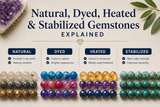
Natural vs. Treated Gemstones: Dyed, Heated and Stabilized Explained
Natural, Dyed, Heated and Stabilized Gemstones Explained When shopping for gemstone beads, you may s …24th Jul 2026