
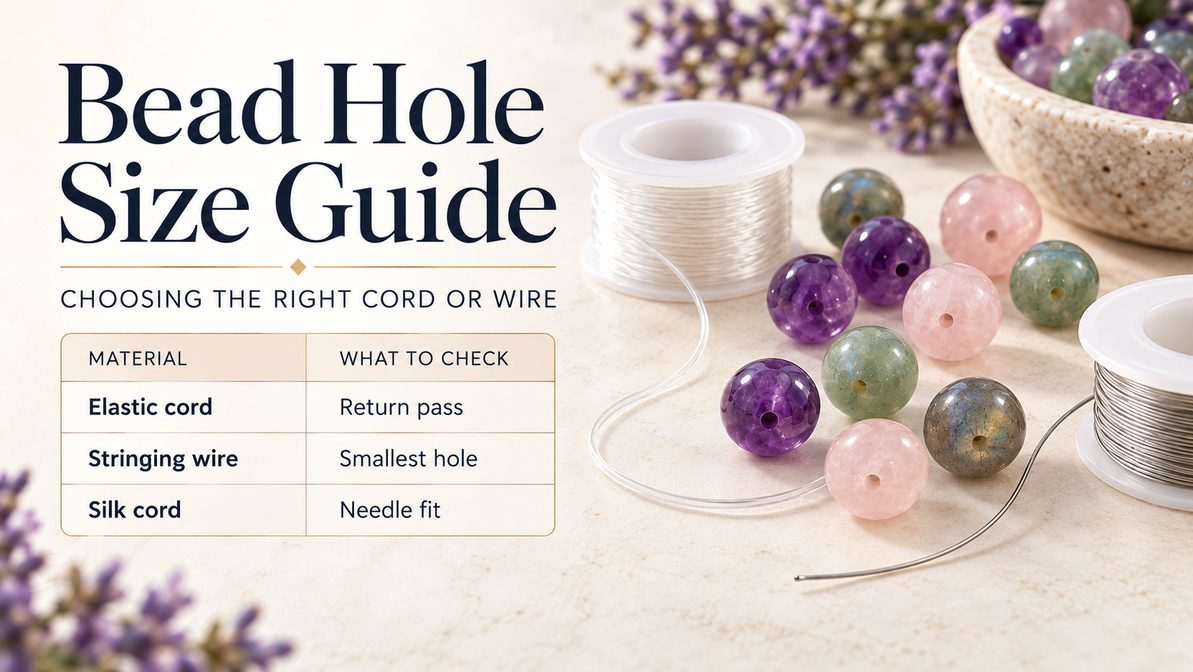
Bead Hole Size Guide: How to Choose the Right Cord or Wire
Bead Hole Size Guide: How to Choose the Right Cord or Wire
An 8 mm gemstone bead tells you how wide the bead is. It does not tell you what will fit through its hole. Two beads with the same outside diameter can have different hole sizes, and holes may vary slightly within the same strand.
If you are planning a stretch bracelet, a clasp bracelet, or a knotted necklace, checking the hole before you start can save frustration. Start by choosing your gemstone beads, then make sure your stringing material fits the entire design.
Bead size and hole size: what's the difference?
Bead size describes the outside dimensions of the bead. Hole size describes the opening drilled through it. The first affects how your jewellery looks; the second helps you choose what to string it on.
Don't assume every 6 mm or 8 mm bead has the same size hole. Check the product details when a hole measurement is listed, especially if you plan to use thicker cord. Our guide to choosing gemstone beads for your jewellery projects covers other details to consider.
Start with the smallest hole in your design
Lay out your gemstone beads, metal spacers, and any bead you plan to use to hide a knot. Your stringing material must pass through the smallest opening among them.
| Project | First fit check | Finishing check |
|---|---|---|
| Stretch bracelet | Does the elastic pass through every bead without force? | Can it pass through a bead again if you need to double back or hide the knot? |
| Clasp bracelet or necklace | Does the flexible stringing wire pass through the smallest bead and spacer? | Is there room where the wire doubles back through the crimp and nearby beads? |
| Knotted necklace | Do both the cord and needle pass through the holes? | Can the cord make any second pass your finishing method requires? |
| Bead links | Does the shaping wire fit without scraping or forcing? | Is there enough wire beyond the bead to form the loops? |
Choosing elastic cord
For a stretch bracelet, choose elastic that passes comfortably through every bead. A cord that barely fits can be difficult to string and may leave no room for a return pass near the knot. For example, a 0.7 mm cord passing through a hole once does not guarantee that two sections will fit through it.
Test several beads from the strand, including any that look tightly drilled, and check your spacers too. If the cord catches, try a thinner size rather than pulling hard. Browse our elastic cords to compare diameters.
Choosing flexible stringing wire
Flexible stringing wire is commonly used for bracelets and necklaces with a clasp. Its listed diameter tells you its thickness. Its strand count describes flexibility; that is a separate specification. If you are working with solid wire to make bead links, see our jewellery wire size guide for gauge conversions.
Choose a diameter that passes through the smallest bead hole. Before cutting your final length, test how you will finish the piece: the wire may need to pass through a crimp, around the clasp, and back through the crimp and nearby beads. Choose crimps and tools suited to your wire. Explore our stringing wires for options.
What about silk or other beading cord?
For a knotted design, check both the cord diameter and the needle. The cord may fit through a bead even when the needle will not. If your finishing method takes the cord back through the last few beads, test that second pass before knotting the entire strand.
Test before stringing the whole piece
- Find the smallest holes among your beads and findings.
- Pass your chosen cord, wire, or needle through several of those pieces. It should move through without force.
- Test any return pass needed at the clasp or knot.
- Check for rough edges around the holes that could catch the cord.
- Make a short sample before stringing the full design.
The simplest rule is to plan around the hole and your finishing method, as well as the bead's outside size. A few minutes of testing will make the rest of the project easier.
Ready to plan your next piece? Browse gemstone beads at Fine Gems Canada and pair them with cord or wire that fits your design. For help planning a bracelet, see our guides to bead counts and wrist measurements.
Recent Posts
-
Bead Hole Size Guide: How to Choose the Right Cord or Wire
Bead Hole Size Guide: How to Choose the Right Cord or Wire An 8 mm gemstone bead tells you how wide …25th Sep 2026 -

12 Most Popular Gemstone Beads for Jewelry Making
12 Most Popular Gemstone Beads for Jewelry Making Gemstone beads are available in an extraordinary …11th Aug 2026 -
Natural vs. Treated Gemstones: Dyed, Heated and Stabilized Explained
Natural, Dyed, Heated and Stabilized Gemstones Explained When shopping for gemstone beads, you may s …24th Jul 2026